 Non·Obvious
Sensing
Non·Obvious
Sensing
Lo que ya está
en pantalla,
convertido en Recomendación Operacional.
A partir de patrones de imagen y señales dentro de bandas confiables, convertimos proxies baratos que ya están en la pantalla en estimaciones de causa-efecto que operativizan una decisión.
Sin instalar sensores nuevos. Miramos la misma pantalla que el operador ya mira, de su lado, y convertimos esa mirada en acciones de valor.
Consumimos nuestra energía en integrar decisiones, no infraestructura.
01 · No integración: read-only, air-gapped por diseño
No se conecta a nada. Solo a la corriente.
Non Obvious Sensing solo mira la pantalla. Read-only, sin red, sin credenciales, sin API y sin un puerto abierto en la operación. Lo único que le entregas es un enchufe y una vista del monitor.
Un asistente de visión del tamaño de un tazón de café. Se ubica frente a la pantalla, la mira con una cámara y entrega recomendaciones construidas con el equipo de la operación. Corre modelos de IA customizados en el borde, local y sin nube. Avisa, no decide: el operador ejecuta. Opera en dos modos: asistente, como apoyo al operador, y vigía, para cubrir un puesto no atendido.
Si en el escritorio cabe un tazón de café, puedes tener un asistente AI.
02 · Por qué existe
La operación ya tiene la señal: está en una pantalla de la sala de control.
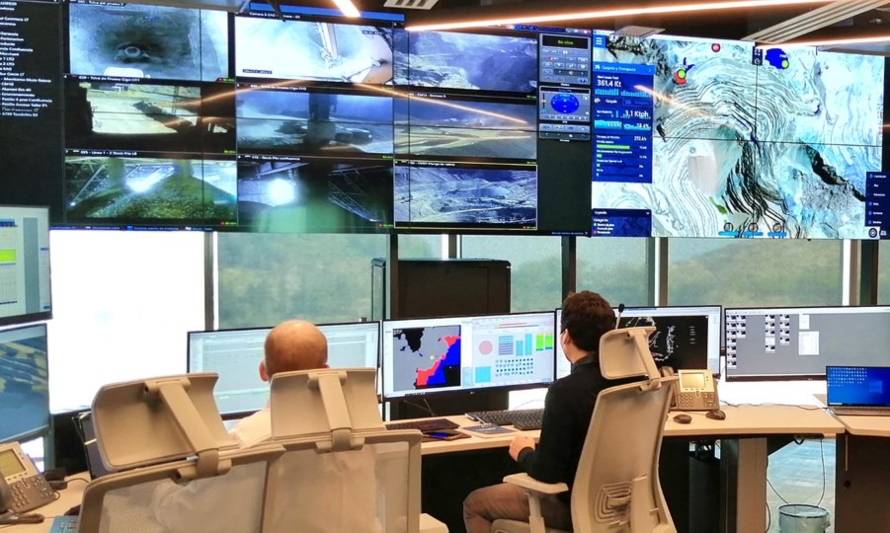
Las salas de control minero tienen 6 a 8 pantallas, algunas con monitoreo de puntos clave de la operación, correas, chancadores, palas, que no están siendo usadas a su máximo potencial.
Existe IA capaz de generar recomendaciones sobre esas señales, pero hoy los costos, la falta de integración de sistemas y las restricciones de convergencia IT/OT dejan ese valor sobre la mesa. El operador está presente, y a veces ausente de noche en algunas faenas. Non Obvious Sensing puede aprender a mirar y recomendar lo que es importante en esa estación de trabajo.
Convertir la pantalla que ya existe en el sensor que falta.
03 · Propuesta de valor
La forma más simple de probar el valor, antes de invertir en integraciones.
Antes de invertir hay que evaluar el esfuerzo de integración y si el caso de uso tiene un caso de negocio que lo financie: ¿hay suficiente valor en la mesa para pagar todo ese esfuerzo? Incorporar sensado nuevo hoy compite con capex, ventanas de parada e integración IT/OT.
Este sistema no pide ninguna de las tres: lee una pantalla que la faena ya tiene, en modo read-only, y entrega la recomendación en el mismo turno en que ocurre el evento. La decisión queda acotada y reversible: se desenchufa y la sala queda exactamente como estaba.
La señal ya está disponible frente a ti.
Aspiramos a habilitar
Ver en pantalla, en el turno en que ocurre, el evento que hoy solo aparece en el reporte de la semana siguiente.
Sumar sensado sin sumar infraestructura: cero integración a los sistemas de la operación, cero intervención en la sala.
Un modelo específico, entrenado para tu pantalla, con los casos de uso y las recomendaciones que le hagan sentido a la operación.
04 · Cómo lo hacemos
El asistente AI está calibrado para transformar tu pantalla en un sensor.
Entrenamos un motor de detección IA para reconocer tu monitor y los patrones de los videos que ya controlas, sin instalar nada. Lo único que necesita para empezar a aprender es un video tomado por la propia cámara del asistente.
No nos conectamos a ningún sistema de la faena. No hay credencial que entregar, ni red que abrir, ni dato que salga de la sala.
Lo único que se necesita es una vista despejada de la pantalla, como si el operador la estuviera mirando. Cuatro esquinas corrigen la geometría real de la sala: la cámara se monta donde hay espacio, no donde el ángulo es ideal.
El asistente se entrena para entender los patrones de tu monitor de control, no de una pantalla genérica. El proceso toma días o semanas según el caso. No meses.
El motor de detección vive dentro del asistente. No hay servicio externo que consultar ni dato que salga de la sala.
Las alarmas se construyen con el cliente: juntos definimos la frecuencia y las acciones que más valor tengan para la operación.
What is already
on the screen,
turned into a decision.
From image patterns and signals read inside reliable bands, we turn cheap proxies already on the screen into cause-and-effect estimates that make a decision actionable.
No new sensors installed. We look at the same screen the operator already looks at, from our side of the glass, and turn that look into actions worth taking.
We spend our energy integrating decisions, not infrastructure.
01 · No integration: read-only, air-gapped by design
It connects to nothing. Only to power.
Non Obvious Sensing only looks at the screen. Read-only, no network, no credentials, no API and not one open port in the operation. All you hand it is a power outlet and a view of the monitor.
A vision assistant the size of a coffee mug. It sits in front of the screen, watches it with a camera and delivers recommendations built with the operation's own team. It runs custom AI models at the edge, local, no cloud. It advises, it does not decide: the operator acts. Two modes: assistant , backing the operator, and lookout, covering an unattended station.
If a coffee mug fits on the desk, an assistant fits too.
02 · Why it exists
The operation already has the signal: it is on a control-room screen.
Mining control rooms run six to eight screens, some of them watching key points of the operation, belts, crushers, shovels, nowhere near their full potential.
AI able to turn those signals into recommendations already exists, but cost, missing system integration and IT/OT convergence constraints leave that value on the table. The operator is there, and on some sites, absent at night. Non Obvious Sensing can learn to watch that workstation and recommend what matters.
Turning the screen that already exists into the sensor that is missing.
03 · Value proposition
The simplest way to prove the value, before investing in integrations.
Before investing you have to weigh the integration effort and whether the use case has a business case that funds it: is there enough value on the table to pay for all that work? Adding new sensing today competes with capex, shutdown windows and IT/OT integration.
This system asks for none of the three: it reads a screen the site already has, read-only, and delivers the recommendation in the same shift the event happens. The decision stays small and reversible: unplug it and the room is exactly as it was.
The signal is already there, right in front of you.
What we aim to enable
Seeing the event on screen, in the shift it happens, instead of in next week’s report.
Adding sensing without adding infrastructure: zero integration with the site’s systems, zero intervention in the room.
A specific model, trained on your screen, with the use cases and recommendations that make sense for your operation.
04 · How we do it
The AI assistant is calibrated to turn your screen into a sensor.
We train an AI detection engine to recognise your monitor and the patterns in the video you already watch, installing nothing. All it needs to start learning is a clip recorded by the assistant’s own camera.
We connect to none of the site's systems. No credential to hand over, no network to open, no data leaving the room.
All it needs is a clear view of the screen, as if the operator were looking at it. Four corners correct the real geometry of the room: the camera mounts where there is space, not where the angle is ideal.
The assistant is trained to understand the patterns of your control monitor, not of a generic screen. The process takes days or weeks depending on the case. Not months.
The detection engine lives inside the assistant. No external service to call, no data leaving the room.
Alarms are built with the client: together we define the frequency and the actions that carry the most value for the operation.

Desalineamiento
GETs · sobretamaños
Atollo · bolones